
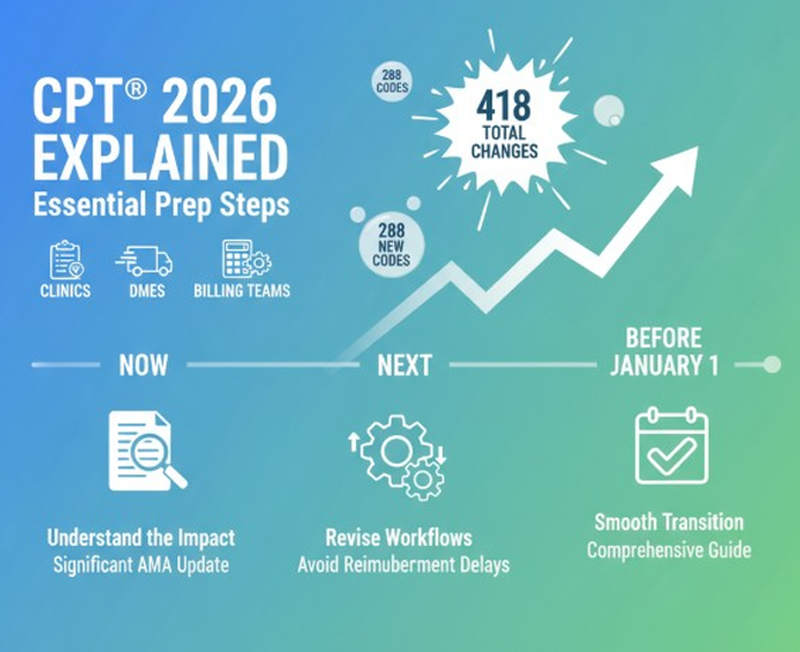
Every year, the healthcare industry braces for updates to the AMA’s CPT code set, but the 2026 update is one of the most significant in recent years. With 418 total changes, including 288 new CPT codes, medical practices, clinics, and DME providers need to begin preparing early to avoid reimbursement delays or operational disruptions.
Below is a comprehensive, practice-friendly guide to what’s changing, how it impacts your workflow, and what proactive steps can be taken early in the year, to help you transition smoothly.
Overview of Key CPT 2026 Changes
The 2026 update brings new adjustments across nearly every major section of CPT®. Here’s a snapshot of what’s new:
- 288 new CPT codes for medical, surgical, diagnostic, and emerging technologies
- 84 deletions of outdated or redundant codes
- 46 revisions impacting code descriptions, guidelines, or time durations
- All changes take effect Jan 1, 2026 (with payer adoption timelines varying)
The one area offering relative stability is Evaluation & Management (E/M) services, which remain largely untouched this year with only less updates. However, practices involved in remote patient monitoring and continuous glucose monitoring (CGM) services should pay more attention. New device-related and RPM codes launched updated time thresholds and reporting expectations, making apt documentation harder than ever.
Therefore, the practices must have their documentation, coding workflows, and billing teams aligned for this year.
Which Areas Will Get Affected The Most in CPT 2026?
Although several sections of healthcare saw minor edits, some of them underwent major restructuring. Here are the most impactful areas for medical practices and DME suppliers:
- Surgery – The surgery section sees one of the largest expansions in this update. New lower-extremity revascularization codes, revised biopsy reporting options, and additional spinal decompression codes reflect advances in procedural care. These changes will affect not only procedural billing but also prior authorization requirements and clinical documentation standards.
- Radiology – Updates include a mix of newly introduced and retired codes, particularly within computed tomographic angiography reporting and surface radiation therapy services. Imaging centers and oncology practices may need targeted education to ensure accurate reporting under the revised framework.
- Medicine Section – It introduces several high-volume additions impacting multiple specialties. New RSV vaccine codes, hearing device evaluation services, and mechanical scalp cooling procedures expand reporting options for primary care, ENT, audiology, and oncology providers. Because these services often involve payer-specific policies, early workflow updates will be essential.
- Pathology & Laboratory – Services continue to evolve with ongoing additions and removals within proprietary laboratory analyses (PLA) codes, reflecting the rapid pace of diagnostic innovation.
What These Changes Mean for Your Medical Practice?
CPT 2026 isn’t just a coding update, instead it is a major operational shift. These updates are surely going to directly impact how practices deliver care, document encounters, and get reimbursed.
The introduction of new CPT codes significantly increases the risk of billing inaccuracies during the transition period, as using outdated codes or misinterpreting revised guidelines can lead to claim denials, delayed reimbursements, and potential compliance issues. High-audit areas such as CGM and RPM billing are particularly sensitive due to strict time-based reporting requirements, making accuracy essential.
At the same time, updated RPM and device-related codes place greater emphasis on precise and detailed documentation, requiring practices to strengthen tracking systems and ensure tighter integration between clinical workflows and EHR records to meet payer expectations. Additionally, new surgical and radiology codes are expected to bring revised prior authorization requirements, meaning incorrect code mapping or outdated order sets could result in rejected claims this year, if workflows are not updated in advance.
With a number of coding changes being introduced simultaneously, ongoing coding education becomes mandatory rather than optional, as practices that delay training may face reimbursement instability and operational challenges during the early months of 2026.
Operational Adjustments Practices Should Make Now
To avoid revenue leakage at all costs the practices and clinics needs to implement these operational steps in 2026:
Preparing at the start of the year can give your practice a leap and significantly reduce revenue leakage during this year’s transition. Practices can simply begin by making sure that their practice management systems and EHR are updated with new CPT codes while removing deleted ones. Documentation templates should also reflect updated language and time-based reporting rules.
Moreover reviewing the charge master to confirm alignment between revised codes, internal fee schedules, and payer allowables has equally important roles. Coding, billing, and clinical teams should receive coordinated training so everyone understands how workflow changes impact documentation and claims submission.
Prior authorization workflows may also require updates, particularly for specialties such as cardiology, oncology, orthopedics, radiology, and urology. Communicating with payers ahead of implementation helps clarify adoption timelines and coverage policies for newly introduced services, including Category III technologies.
Conclusion
CPT 2026 is extensive, and the transition can feel overwhelming for practices that rely heavily on accurate coding and streamlined billing, especially when it comes to areas like CGM billing, CGM RPM billing, remote monitoring, and major specialty code updates. As payers adjust at different speeds and documentation rules tighten, practices need structured support to avoid compliance risks and prevent revenue disruptions. This is exactly where Med Karma steps in!
With over 27 years of industry expertise, we provide comprehensive support through every stage of the transition, from updating PMS, EHR, and billing systems with new CPT codes to helping teams understand specialty-specific changes that directly affect reimbursements and documentations. Our coding professional works as a bridge and helps the practices crosswalking old-to-new CPT codes, ensuring a smooth implementation without workflow confusion.
During the transition period, we offer real-time claim audits to avoid early-year denials and offer continuous RCM oversight so your revenue remains stable. Additionally, Med Karma backs sensitive, high-audit areas such as RPM, CGM, and surgical coding, and guides practices through the complexities of Category III technologies, covering documentation, payer requirements, and appeals.
With our well-trained coders, auditors, and billing besides you, your practice can navigate CPT® 2026 with confidence, and without disturbing the cash flow. We ensure you’re fully prepared for the year, operationally, clinically, and financially.